
Field observation
What should you notice first?
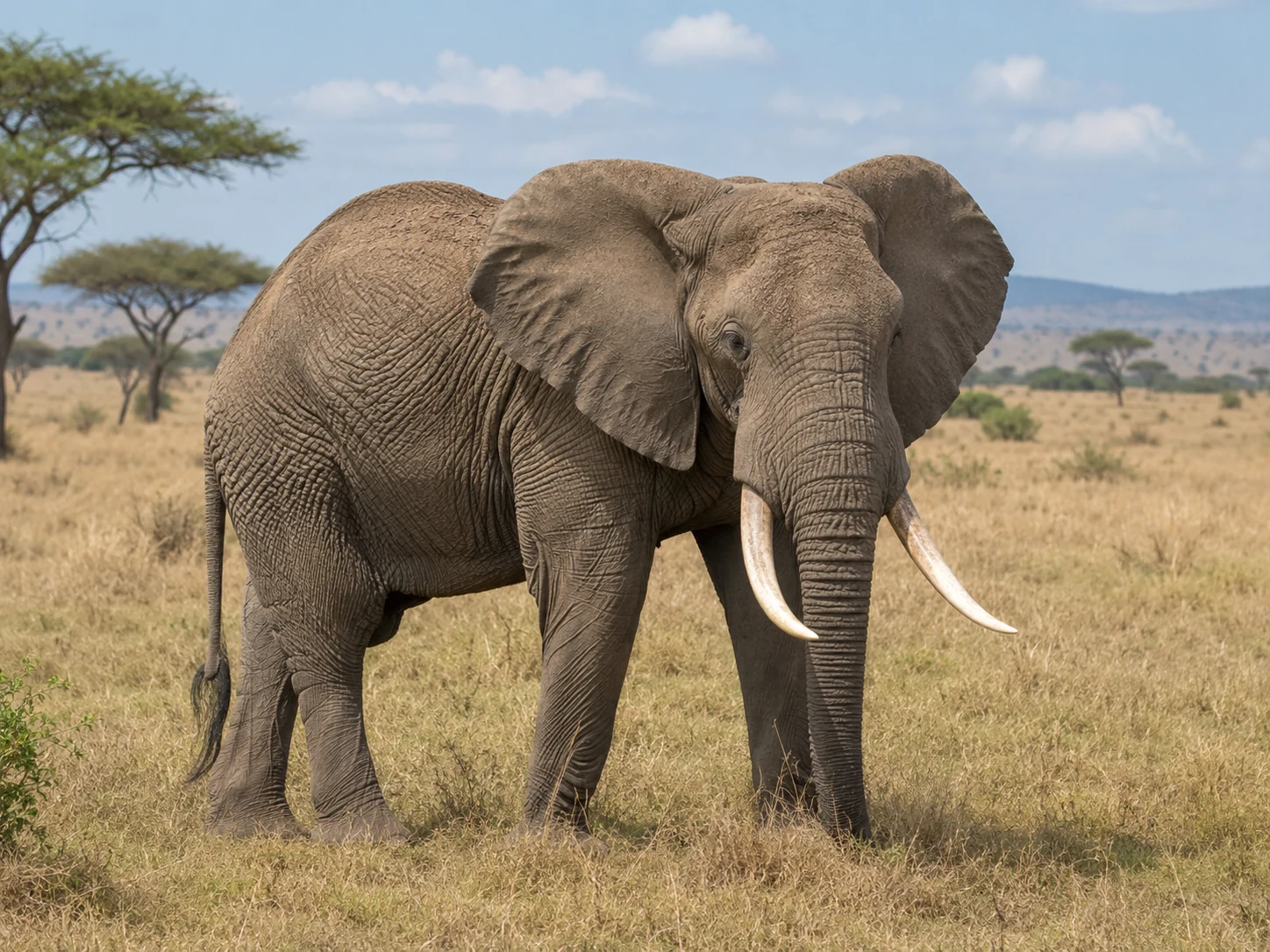
Begin with the whole animal and the whole scene. A confident identification comes from several independent clues—not from moving closer.
What first-time visitors usually notice
- A relaxed elephant may feed steadily with soft ears and an unhurried trunk.
- Head high, ears spread, trunk curled or tucked, displacement feeding and repeated attention to a vehicle can show concern.
- A mock charge and a determined charge are not something visitors should try to diagnose at close range. Create distance early.
What experienced guides look for
- The matriarch's position and how calves are being shielded.
- Dust direction and wind, which affect what elephants can smell.
- Broken branches, dung age, footprints and feeding signs before the animals themselves appear.
Interpretation
What might the behaviour mean?
Feeding, walking, dust bathing, mud wallowing, touching and caring for calves occupy much of elephant life. They also modify vegetation, open pathways and disperse seeds.
Social structure
Family groups consist mainly of related females and their young, led through experience rather than simple dominance. Mature bulls often travel alone or in male associations.
Communication
Elephants communicate with touch, scent, posture, trumpets and very low rumbles that can travel over long distances.
Breeding
Pregnancy lasts about 22 months, the longest known for a land mammal. Calves receive care from their mothers and other females in the family.
Regional context
Where does this encounter fit?
Residential bushveld context
Elephants do not normally roam through Marloth Park's residential area. Visitors may see them across the Crocodile River boundary or during a Southern Kruger drive.
Park and river context
Widely distributed in Kruger, but sightings remain unpredictable and road conditions must always be respected.
Best places to look
Use Crocodile River viewpoints from Marloth Park without approaching the boundary fence. In Southern Kruger, river roads, water sources and broad woodland can be productive, but elephants may appear anywhere.
Best time of day
Elephants can be active all day. Cooler hours and visits to water during heat can offer rewarding behaviour.
Seasonal behaviour
Dry-season movement often focuses more strongly on permanent water and remaining forage. Wet-season food allows wider dispersal.
Ecosystem role
How does this animal fit into the Lowveld?
Elephants use woodland, savanna, river systems and seasonal water sources. Their movements respond to water, food, heat, social needs and disturbance.
Conservation meaning
Kruger's elephants are locally visible, but the African savanna elephant is globally Endangered. Conservation must balance population security, connected landscapes and the ecological effects of very large herbivores.
During the encounter
Photograph and view without changing the behaviour.
Photography
- Use a wider lens to show family spacing and habitat instead of forcing a close portrait.
- Never edge closer for a frame when an elephant is watching you.
- Do not trap yourself between elephants, other vehicles and a road edge.
Ethical viewing
- Avoid crowding, revving, hooting or repeatedly repositioning around a herd.
- Give bulls in musth and family groups with young calves extra room.
- Leave the sighting while it is still calm.
Safety
- Keep a generous escape route and reverse before the elephant needs to demand space.
- Never switch off in a position where you cannot move safely.
- Do not drive between a mother and calf or through a herd.
- Remain in your vehicle in Kruger except at designated places.
Visitor questions
Curiosity without exaggeration.
Common myths
Elephants flap their ears for cooling and communication. Read the whole body and keep safe distance rather than relying on one sign.
Vehicle size does not remove risk. Position, distance and the animal's choices matter.
Frequently asked questions
Are elephants inside Marloth Park?
They are not normally free-roaming in the residential area. Visitors commonly look across the Crocodile River or drive into Southern Kruger.
What should I do if an elephant approaches my car?
Stay calm, keep the engine ready, avoid sudden noise and create distance while a clear route remains. Do not wait for a close confrontation.
Why do elephants throw dust?
Dust can help with skin protection, cooling and insect irritation, and may also occur during social or excited behaviour.
Junior Explorer fact
An elephant's trunk contains tens of thousands of muscle units and can lift, smell, drink, touch and communicate.
- Elephants can detect low-frequency calls through both air and ground vibrations.
- Tusks are enlarged incisor teeth.
- Elephant dung moves seeds and nutrients through the ecosystem.
Evidence and review
Scientific and park sources.
Sources support the biological facts and regional context. Field conditions remain variable, and new evidence should trigger review rather than silent correction.
- Kruger National Park Mammals Checklist — South African National Parks
- Mammals of Kruger National Park — South African National Parks
- African Savanna Elephant assessment — IUCN Red List