
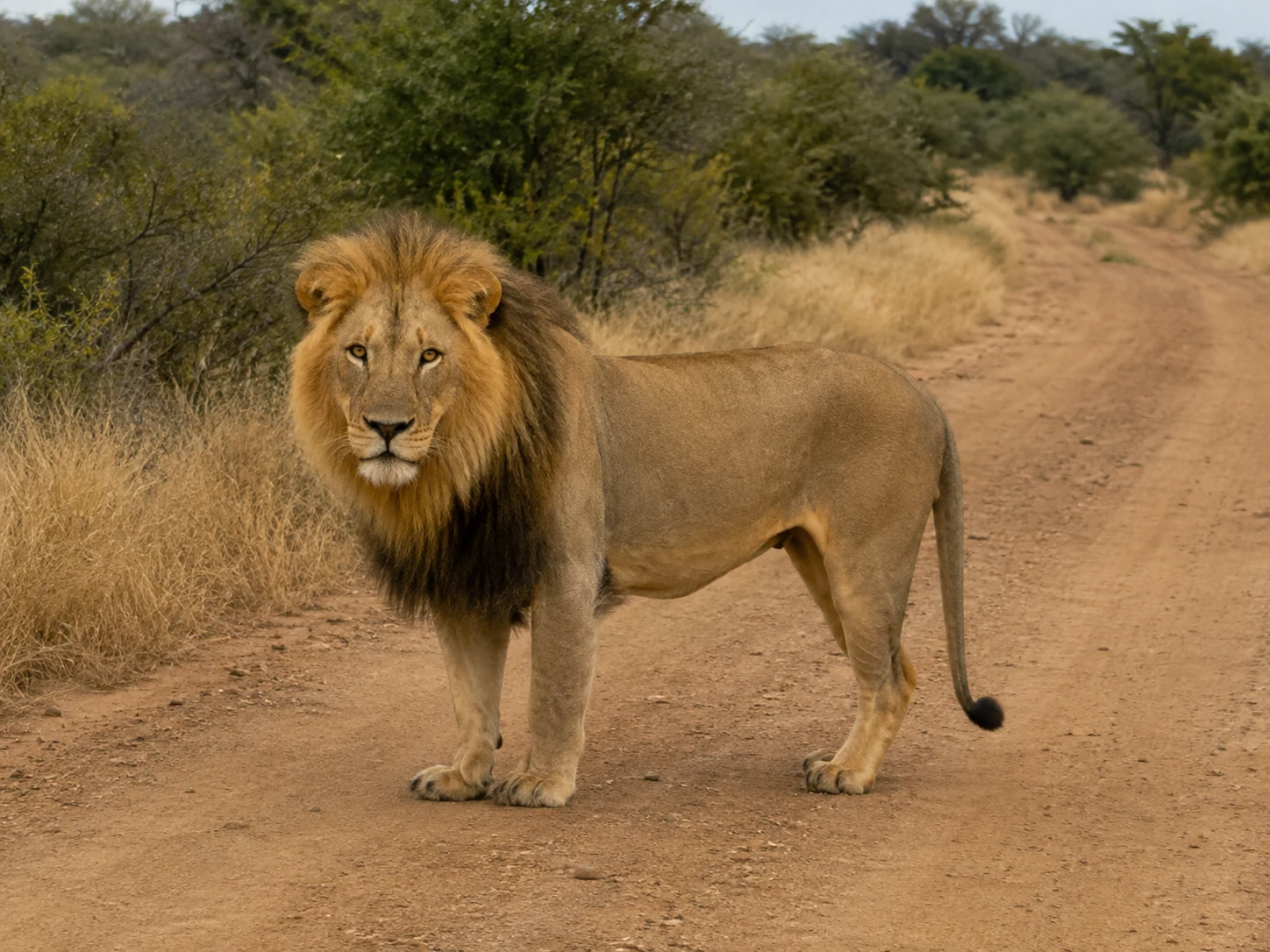
Field observation
What should you notice first?
Begin with the whole animal and the whole scene. A confident identification comes from several independent clues—not from moving closer.
What first-time visitors usually notice
- Resting is not 'doing nothing'. Watch ear movements, greeting, grooming, cub play and which individual chooses shade.
- A focused crouch, flattened profile and coordinated movement may indicate hunting interest.
- Roaring is often territorial or contact communication, not proof that a hunt is happening.
What experienced guides look for
- Herbivores staring, bunching or alarm calling.
- Vultures, hyenas or jackals that may indicate a carcass.
- Tracks on sandy road edges and drag marks crossing the road.
Interpretation
What might the behaviour mean?
They conserve energy by resting for long periods, especially in heat. Social contact, territorial patrols, hunting and feeding often increase in cooler hours or at night.
Social structure
A pride commonly centres on related females and their offspring. One or more males may hold tenure with the pride for a period, while other males form coalitions.
Communication
Roaring, scent marking, scraping, facial expression, tail position and affectionate rubbing all communicate identity, territory and mood.
Breeding
Cubs are born in a secluded place and introduced to the pride later. Their survival depends on food, protection and social stability.
Regional context
Where does this encounter fit?
Residential bushveld context
A lion is not a normal free-roaming sighting in Marloth Park's residential area. Hear or see lions across the river only under suitable circumstances; Southern Kruger is the appropriate place to look.
Park and river context
Southern Kruger supports lions, but they may be hidden, inactive or far from the road. No route can guarantee a sighting.
Best places to look
In Southern Kruger, open areas, river corridors and places with abundant prey can be productive. Route Atlas wildlife notes indicate possibilities, not promises.
Best time of day
Early morning and late afternoon offer better chances of movement. Midday sightings often involve resting lions in shade.
Seasonal behaviour
Lions adjust to prey distribution, water and heat. Dry-season water concentration can influence hunting opportunities, while wet-season cover changes visibility.
Ecosystem role
How does this animal fit into the Lowveld?
Lions use many habitats as long as prey, water and cover are available. In Southern Kruger they move through open savanna, woodland and river systems.
Conservation meaning
Protected landscapes such as Greater Kruger are crucial for lions, whose wider populations are pressured by habitat loss, declining prey and conflict with people.
During the encounter
Photograph and view without changing the behaviour.
Photography
- Do not demand movement from a resting lion. Photograph social details, paws, tails and the wider scene.
- Keep windows and doors closed where rules require and never lean out.
- Avoid creating a vehicle wall that blocks the pride's route.
Ethical viewing
- Give hunting animals space and do not position a vehicle to alter prey movement.
- Keep voices low around cubs and feeding lions.
- Do not share precise real-time locations of sensitive sightings in ways that create dangerous crowding.
Safety
- Remain inside your vehicle in Kruger except at officially designated areas.
- Never follow lions off road or leave a vehicle for a better view.
- At Marloth's boundary, stay behind permitted viewing areas and never approach the fence because predators are across the river.
Visitor questions
Curiosity without exaggeration.
Common myths
Females often lead cooperative hunts, but males also hunt, defend territories and compete at great energetic cost.
Roaring is mainly long-distance communication. Immediate risk must be judged from distance, posture and context—not the sound alone.
Frequently asked questions
Where can I see lions near Marloth Park?
Southern Kruger is the responsible place to look. They are regularly recorded in the region, but never guaranteed.
Why do lions sleep so much?
Rest conserves energy for hunting, territorial movement, feeding and social conflict.
Is a lion dangerous inside a car?
A closed vehicle used according to park rules offers protection, but careless behaviour—open doors, leaning out or leaving the vehicle—creates severe risk.
Junior Explorer fact
A lion's rough tongue has tiny backward-facing structures that help remove meat from bone and groom fur.
- Lionesses are usually the stable core of a pride.
- A roar can carry several kilometres under suitable conditions.
- Male coalitions may be brothers, relatives or unrelated partners.
Evidence and review
Scientific and park sources.
Sources support the biological facts and regional context. Field conditions remain variable, and new evidence should trigger review rather than silent correction.
- Kruger National Park Mammals Checklist — South African National Parks
- Mammals of Kruger National Park — South African National Parks
- Lion assessment — IUCN Red List