
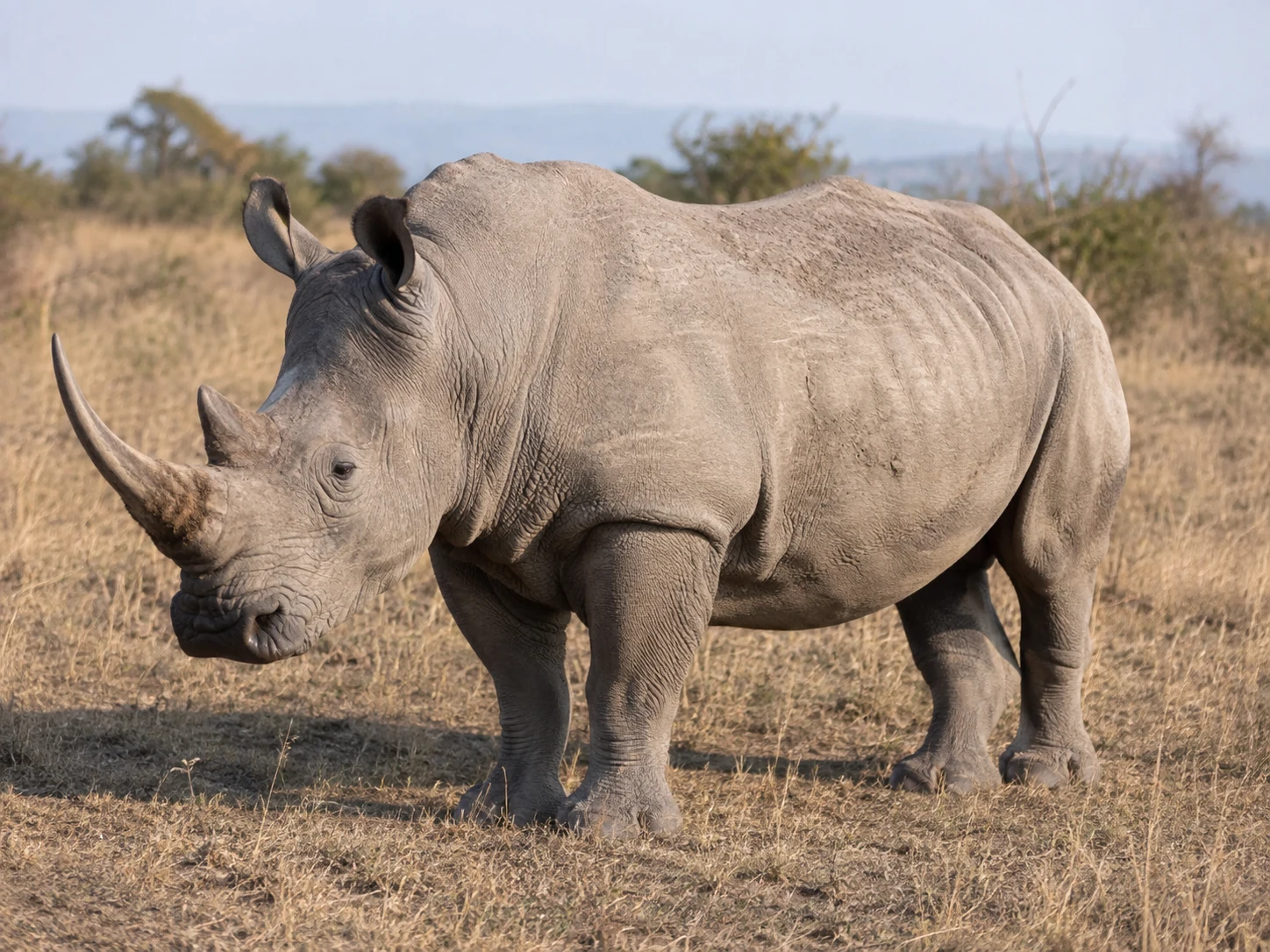
Field observation
What should you notice first?
Begin with the whole animal and the whole scene. A confident identification comes from several independent clues—not from moving closer.
What first-time visitors usually notice
- Head raised, ears fixed and repeated orientation toward a vehicle show increasing attention.
- Dung middens are communication sites and may be used repeatedly.
- Calves often walk ahead of the mother, unlike black rhino calves that often follow.
What experienced guides look for
- Broad grazing lip and head posture to distinguish white from black rhino.
- Three-toed tracks and scraped dung at a midden.
- Oxpecker reactions and ear movement, because rhino vision is limited compared with smell and hearing.
Interpretation
What might the behaviour mean?
Grazing, resting in shade, wallowing, rubbing and visiting middens shape much of daily life. Bulls patrol and scent mark territories.
Social structure
Adult bulls are often territorial and solitary. Females may occur with calves or in loose associations.
Communication
Dung, urine spraying, tracks, scent, snorts and body posture communicate identity and territory.
Breeding
A single calf is born after a long pregnancy and may remain with its mother for several years.
Regional context
Where does this encounter fit?
Residential bushveld context
White rhinos do not normally roam through Marloth Park's residential area. Responsible viewing takes place in Southern Kruger.
Park and river context
Present in Southern Kruger, but sightings are never guaranteed and exact locations should be treated sensitively because of poaching.
Best places to look
Southern Kruger grasslands and open woodland can produce sightings. MPC deliberately avoids publishing precise rhino locations.
Best time of day
Cooler hours are good for grazing. During heat, rhinos may rest in shade or visit wallows.
Seasonal behaviour
Dry conditions can increase use of water, wallows and remaining grazing. Rain spreads animals into fresh grass.
Ecosystem role
How does this animal fit into the Lowveld?
White rhinos favour grassland and open savanna with water, shade and suitable wallows.
Conservation meaning
The conservation category does not capture the urgency visitors see in Southern Africa. Rhino poaching remains severe. Never publish precise live locations or identifiable landscape clues.
During the encounter
Photograph and view without changing the behaviour.
Photography
- Remove or crop GPS metadata before sharing images.
- Avoid including road signs, kilometre markers or unique landmarks that reveal location.
- Photograph quietly from the road and never pressure a rhino to stand or turn.
Ethical viewing
- Do not post a live location.
- Do not crowd a resting rhino or a midden.
- Report suspicious activity through official channels rather than confronting anyone.
Safety
- Remain in the vehicle and leave a broad escape route.
- Do not drive between a mother and calf.
- A rhino that is trying to identify your smell or sound may turn quickly; do not approach.
Visitor questions
Curiosity without exaggeration.
Common myths
They are grey. The name is probably linked to the broad or 'wide' mouth.
It is keratin and has no scientifically established curative benefit. Demand drives lethal poaching.
Frequently asked questions
Where can I see rhino near Marloth Park?
They occur in Southern Kruger, but MPC does not publish precise locations. Search responsibly and treat every sighting as sensitive.
How do I tell white and black rhino apart?
The white rhino has a broad square grazing lip and usually carries its head lower. The black rhino has a hooked browsing lip.
Should I share a rhino sighting online?
Do not share a live or precise location. Remove GPS data and landscape clues before posting later.
Junior Explorer fact
The name 'white rhino' probably developed from a word describing its wide mouth—not its colour.
- White and black rhinos are both grey.
- The front horn is made of keratin, the same family of material as human hair and nails.
- Rhino middens work like information boards made of scent.
Evidence and review
Scientific and park sources.
Sources support the biological facts and regional context. Field conditions remain variable, and new evidence should trigger review rather than silent correction.
- Kruger National Park Mammals Checklist — South African National Parks
- Mammals of Kruger National Park — South African National Parks
- White Rhinoceros assessment — IUCN Red List