
Field observation
What should you notice first?
Begin with the whole animal and the whole scene. A confident identification comes from several independent clues—not from moving closer.
What first-time visitors usually notice
- Repeated yawning may be a threat display, not tiredness.
- Dung spraying and tail flicking can mark territory.
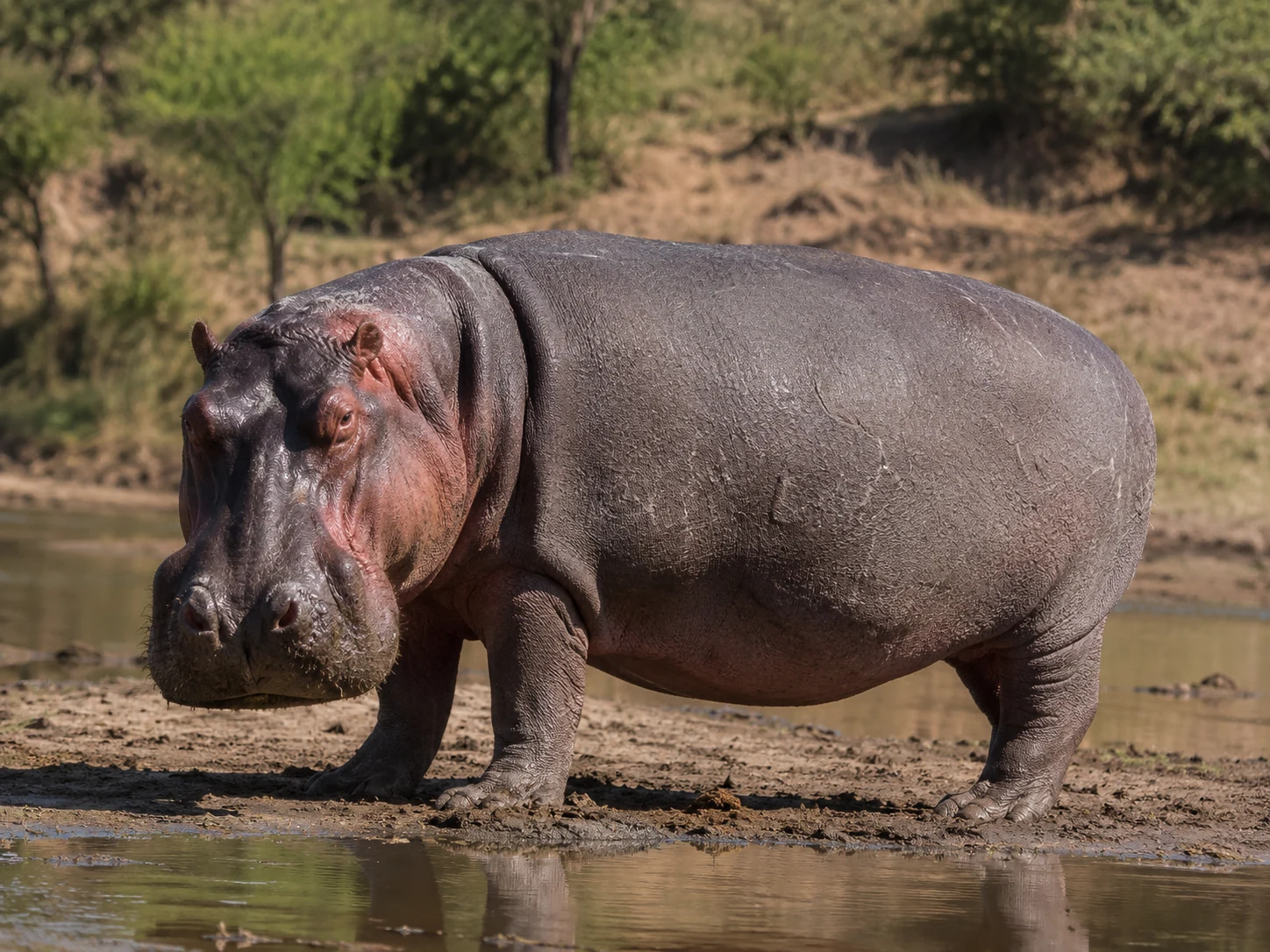
- A hippo on land may be moving between water and feeding areas. Never stand in its path.
What experienced guides look for
- Paths leading from water to night grazing areas.
- Fresh dung splashes on banks and vegetation.
- Subtle nostril, ear and eye movements that show where a mostly submerged animal is facing.
Interpretation
What might the behaviour mean?
Daytime groups rest, surface, vocalise and jostle in water. At night individuals may travel kilometres to graze.
Social structure
Groups in water may include a territorial male, females and young. These are spatial associations rather than tightly cooperative family herds.
Communication
Grunts, honks, bellows, splashing, yawning and dung marking communicate in and around water.
Breeding
Mating and birth commonly occur in water. Calves nurse both on land and underwater and remain close to their mothers.
Regional context
Where does this encounter fit?
Residential bushveld context
Hippos may be seen or heard along the Crocodile River from appropriate Marloth Park viewpoints. They are not animals to approach on the riverbank.
Park and river context
Regular in suitable rivers, dams and pools across Southern Kruger.
Best places to look
Use established Crocodile River viewpoints in Marloth Park and designated bridges, dams and viewpoints in Southern Kruger. Never approach an unprotected bank for a closer look.
Best time of day
Daylight viewing is easiest at water. Calls may be heard after dark, when hippos are more likely to move on land.
Seasonal behaviour
As water contracts in the dry season, hippos may crowd into remaining pools, increasing competition and ecological pressure.
Ecosystem role
How does this animal fit into the Lowveld?
Hippos need permanent or long-lasting water deep enough for daytime refuge, with grazing available on surrounding land.
Conservation meaning
Hippos depend on functioning rivers, safe grazing areas and water quality. River protection benefits entire Lowveld ecosystems.
During the encounter
Photograph and view without changing the behaviour.
Photography
- Use reflections, ears and eyes to show how little of the body is exposed.
- Wait for natural surfacing rather than making noise.
- Never move closer to a bank or leave a vehicle for a low-angle image.
Ethical viewing
- Avoid loud noise at resting pools.
- Do not throw food or objects into the water.
- Give lone animals on land an especially wide berth.
Safety
- Keep far away from hippos on land and never block their route to water.
- Do not walk along dark riverbanks or between a hippo and the river.
- Use designated viewing areas and remain inside your vehicle where required.
Visitor questions
Curiosity without exaggeration.
Common myths
Diet does not predict temperament. Hippos are territorial around water and dangerous when people block movement routes.
They can move quickly on land over short distances.
Frequently asked questions
Can hippos be seen from Marloth Park?
Yes, they may be seen or heard along the Crocodile River from safe, established viewpoints.
Why do hippos yawn?
A wide gape can display the teeth during a threat or dominance interaction. It is not always tiredness.
Do hippos eat fish?
Their normal diet is overwhelmingly grass, although unusual opportunistic feeding has been recorded.
Junior Explorer fact
A hippo can close its nostrils and ears when it goes underwater.
- Hippos produce reddish skin secretions that help protect the skin; this is not blood.
- They graze mainly on land, usually at night.
- Their underwater calls can travel through both water and air.
Evidence and review
Scientific and park sources.
Sources support the biological facts and regional context. Field conditions remain variable, and new evidence should trigger review rather than silent correction.
- Kruger National Park Mammals Checklist — South African National Parks
- Mammals of Kruger National Park — South African National Parks
- Hippopotamus assessment — IUCN Red List