
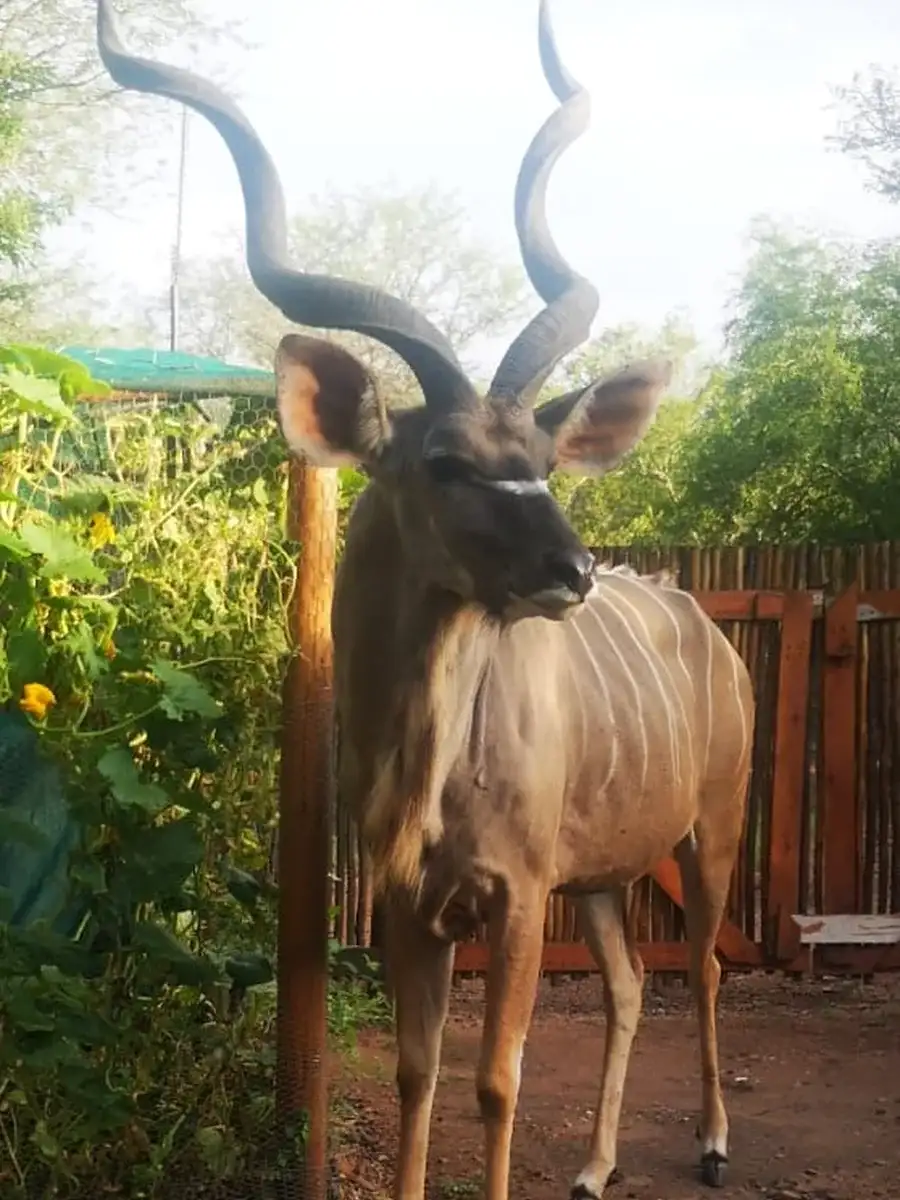
Field observation
What should you notice first?
Begin with the whole animal and the whole scene. A confident identification comes from several independent clues—not from moving closer.
What first-time visitors usually notice
- Kudu can remain motionless in surprisingly light cover. Search for an ear, horn curve or white stripe rather than the whole animal.
- A loud bark may be an alarm call.
- Males often look heavier and darker with age, with a visible neck mane and large spiralled horns.
What experienced guides look for
- Freshly browsed branch tips and kudu tracks near thickets.
- The direction of those oversized ears—each can turn toward a different sound.
- A female pausing before young animals follow from cover.
Interpretation
What might the behaviour mean?
Kudu rely heavily on concealment, careful listening and a powerful bounding escape. They may freeze first, then move away with long, effortless jumps.
Social structure
Females and young form small groups. Adult males are often solitary or occur in loose bachelor groups outside the breeding period.
Communication
Posture, scent and a deep alarm bark are important. The bark can carry through woodland and may alert other animals.
Breeding
Calves are hidden in cover for part of the day when very young. Females return to nurse them until they are ready to follow more openly.
Regional context
Where does this encounter fit?
Residential bushveld context
Regularly encountered around bushy stands and quieter roads in Marloth Park.
Park and river context
Widespread but easier to miss than impala because kudu often stand partly hidden in thickets.
Best places to look
In Marloth Park, scan dense stands, shady verges and the edges of open clearings. In Southern Kruger, slow down near drainage lines, rocky country and mixed woodland.
Best time of day
Early morning, late afternoon and overcast days often produce the easiest viewing.
Seasonal behaviour
Leaf quality and water availability influence local movement. In the dry season, kudu may concentrate around remaining browse and water.
Ecosystem role
How does this animal fit into the Lowveld?
Greater kudu favour woodland, broken bush, rocky slopes and dense drainage lines. Cover matters because they browse and avoid danger among trees and shrubs.
Conservation meaning
Healthy kudu populations depend on connected woodland and responsible land use. Feeding around homes can disturb natural browsing and normal movement.
During the encounter
Photograph and view without changing the behaviour.
Photography
- Use the stripes and spiral horns to create a portrait that still shows some habitat.
- Expose carefully when the animal stands in patchy shade.
- Do not push closer when a kudu has frozen; this is often a sign it is deciding whether to flee.
Ethical viewing
- Do not feed kudu from a patio or vehicle.
- Avoid surrounding an animal with several vehicles.
- Let females with calves move into cover without being followed.
Safety
- Give kudu space around roads; they can leap suddenly.
- Never approach a cornered or injured animal.
- Keep dogs controlled and away from wildlife.
Visitor questions
Curiosity without exaggeration.
Common myths
Horn development gives only a broad clue. Nutrition, genetics, wear and individual growth vary.
Freezing is a defence. The animal may be relying on camouflage before deciding whether to flee.
Frequently asked questions
Why are kudu difficult to see?
Their muted coat, narrow stripes and habit of standing still in broken shade make them blend into woodland.
Do female kudu have horns?
Female greater kudu normally do not have horns.
Are kudu dangerous?
They normally avoid people, but any wild animal can defend itself if trapped, injured or approached too closely.
Junior Explorer fact
A kudu's huge ears work like movable listening dishes.
- A mature male's horns twist rather than forming simple circles.
- Kudu stripes help break up the body outline in woodland shade.
- Their alarm bark can sound unexpectedly dog-like.
Evidence and review
Scientific and park sources.
Sources support the biological facts and regional context. Field conditions remain variable, and new evidence should trigger review rather than silent correction.
- Kruger National Park Mammals Checklist — South African National Parks
- Mammals of Kruger National Park — South African National Parks
- Greater Kudu assessment — IUCN Red List