01What “Junior Ranger” means at MPC
MPC Kidz uses ranger-style themes to make wildlife learning practical: notice a clue, compare evidence, record what was seen and discuss why a safety or conservation choice matters. It does not certify a child as a ranger and does not claim SANParks endorsement.
The distinction matters because the learning should increase respect for boundaries. A good ranger-style task teaches a child to stop, observe and leave space — not to handle an animal, collect specimens or move closer to prove an answer.
02Ages 6–8: Junior Safari Ranger
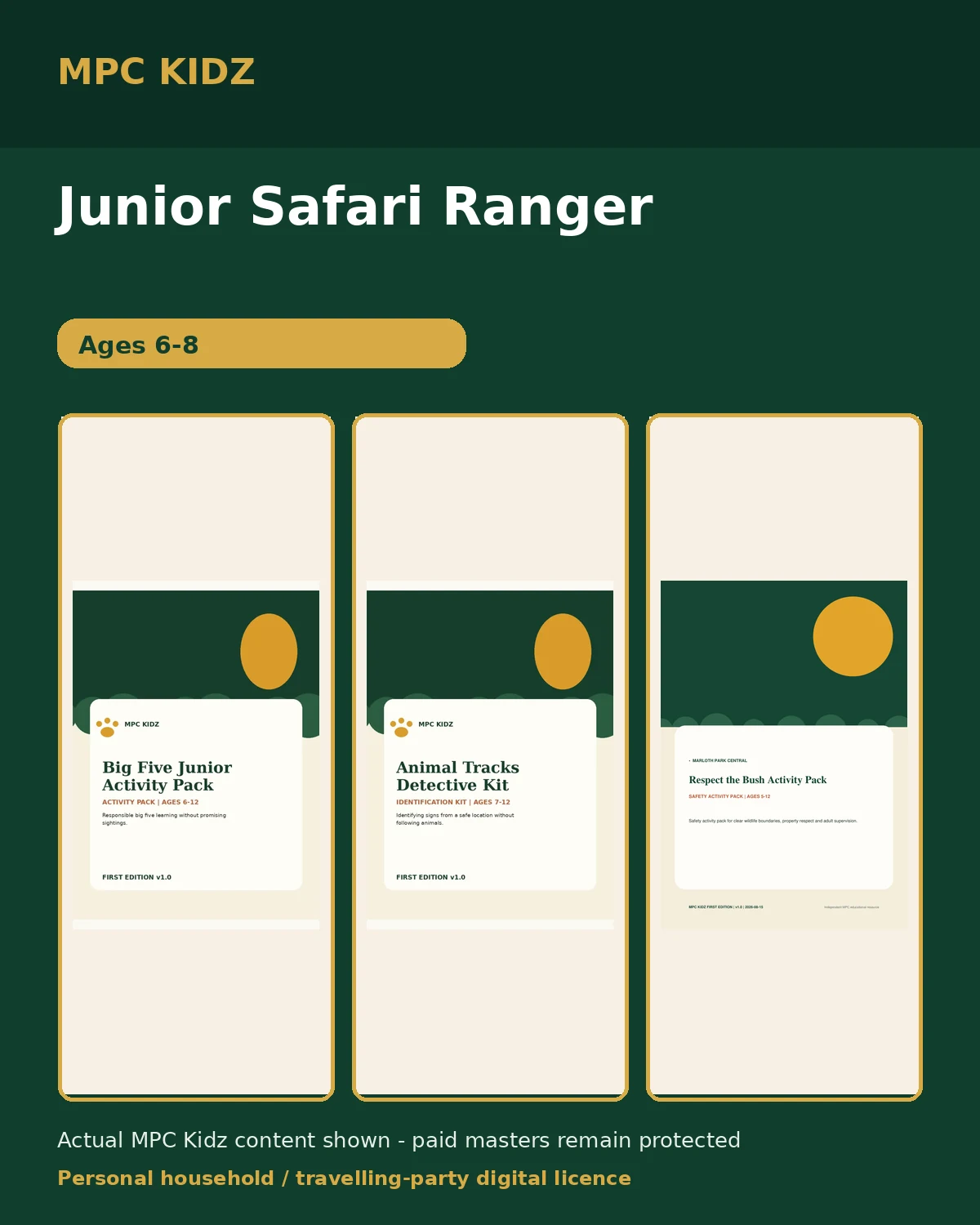
The fixed 13-activity Junior Safari Ranger pack combines Big Five learning, wildlife bingo, memory matching, tracks, spotting, respectful-bush guidance, achievement badges, scavenger prompts, a holiday journal, wildlife passport, word searches, mazes and a treasure-hunt format.
This age band supports early independent readers but still works as shared family participation. Adults remain responsible for where and how any real-world observation happens.
03Ages 9–12: move from clues to explanations
The Bush Detective pack becomes materially more advanced. It includes a junior field guide, tracks, “Who Left This Behind?” evidence work, tree identification, Junior Ranger course material, conservation, food-chain learning, predator/prey reasoning, wildlife sudoku, photography and Kruger/Marloth geography.
The change is not just more pages. The child is asked to justify an answer, compare possibilities and understand that incomplete evidence can remain uncertain.
04Teen work: research rather than a relabelled junior pack
Ages 13–16 use a separate Young Wildlife Expert library: Wildlife Research Field Notebook, Safari Photography Field Lab, Lowveld Ecology Systems Lab, Track & Sign Evidence Lab, Conservation Decisions Casebook, Southern Kruger Challenge Lab, Species Identification & Verification Lab and Advanced Route Reasoning Lab.
These modules keep the same wildlife-safe boundary. Research and route reasoning are educational; they do not become live navigation, wildlife tracking or permission to enter restricted places.