01Start with wildlife observation, not wildlife contact
Marloth Park is a wildlife residential conservancy, so the strongest children’s activities are the ones that help a family notice what is already happening around them. A spotting book, matching game, track clue or journal prompt can turn waiting and watching into an activity without asking a child to approach an animal.
MPC Kidz safety rules remain simple: adults supervise younger children; nobody feeds, touches, chases or crowds wildlife; and every animal keeps space and an unobstructed escape route. The activity is the observation itself, not getting closer for a better result.
- Use zoom or binoculars instead of closing distance.
- Keep food and activity materials secure when wildlife is nearby.
- Use short observation blocks so children can reset before attention becomes frustration.
02Mix free browser play with printable activities
The first four MPC Kidz browser games — Wildlife Quiz, Track Detective, Wildlife Memory and Safari Bingo — are free and need no account or payment. They work as a low-friction way to test what style of activity holds attention before a parent considers a larger pack.
The deeper activity library includes colouring, spotting, scavenger prompts, wildlife passports, journals, tracks, conservation work, photography challenges and older-child reasoning material. The catalogue is intentionally a discovery layer; parents are not expected to assemble a holiday by buying dozens of individual items.
- Use a browser game during a quiet indoor break.
- Print one or two pages for the next drive rather than carrying an entire library.
- Record a sighting after the animal has moved away instead of making the record while blocking a road or animal path.
03Choose the level by age and independence
Ages 3–5 use a highly visual seven-activity Little Explorer Safari Pack, with adult-led use where the original material requires it. Ages 6–8 move into the 13-activity Junior Safari Ranger pack with tracks, spotting, puzzles, missions, journal and passport work. Ages 9–12 use the more advanced 11-activity Bush Detective pack, and ages 13–16 receive a separate eight-workbook Young Wildlife Expert library built around research, evidence, ecology and deeper reasoning.
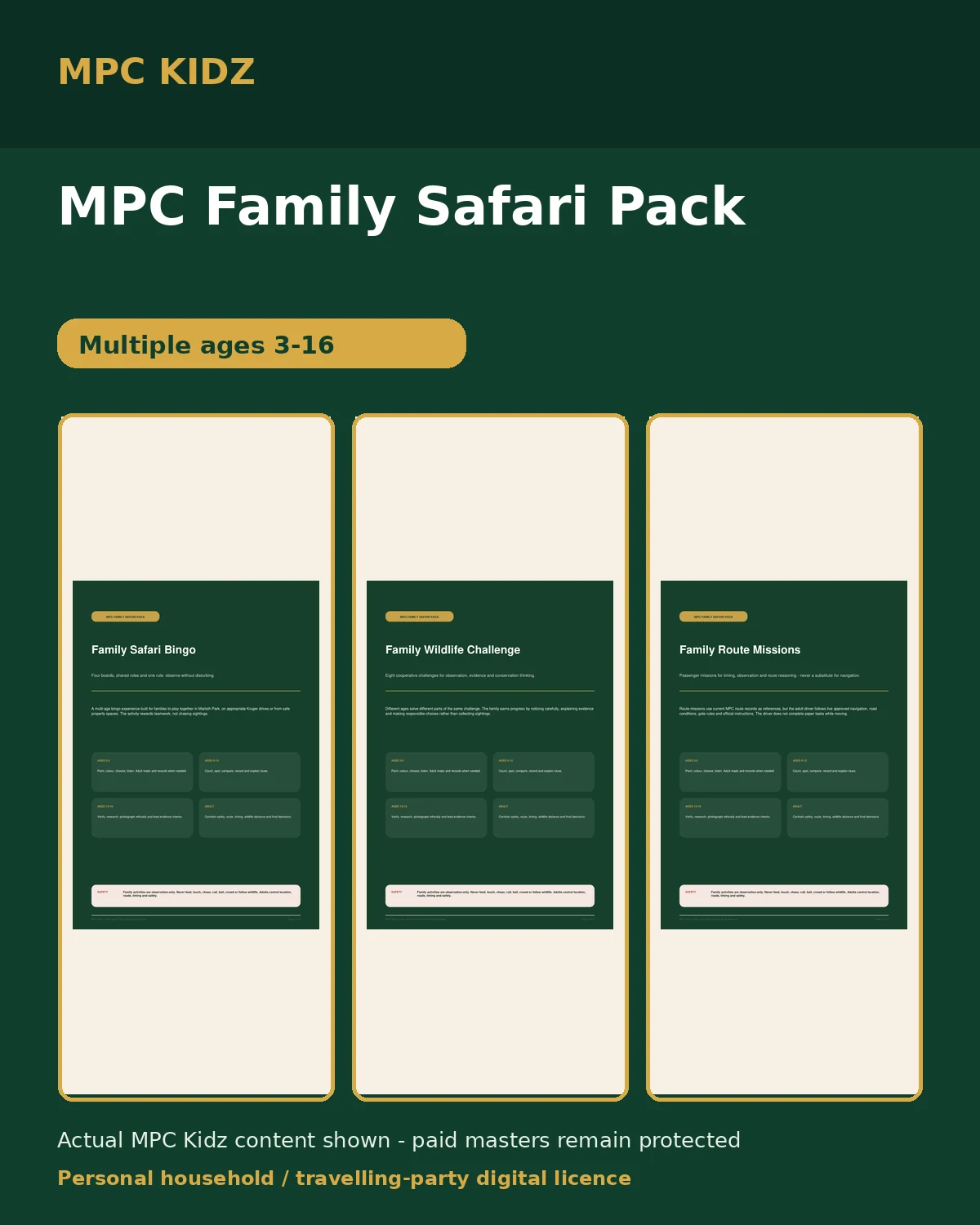
A household travelling with two or more age bands can compare the Family Safari Pack, which compiles the four age packs once, deduplicates legitimate overlaps and adds six Family-exclusive collaborative modules.
04Use the day’s rhythm instead of forcing a schedule
A useful family routine can be small: one short activity before a drive, one observation goal while travelling, and one drawing, puzzle or journal page after returning. Rain, heat, tiredness and changing safari plans are normal, so the activity system should flex around the trip rather than become another timetable.
The MPC Kidz storefront keeps adult commercial decisions separate from children’s play. Product pages can explain a pack even while the purchase switch is off; an unfinished or unreleased product does not become sellable merely because a parent discovers it through search.