01Teen material needs a different cognitive level
A teenager can work with competing explanations, evidence quality, systems relationships and the limits of a conclusion. The Step 11 build therefore created a new teen library instead of simply increasing the age label on younger printables.
02The eight Young Wildlife Expert workbooks
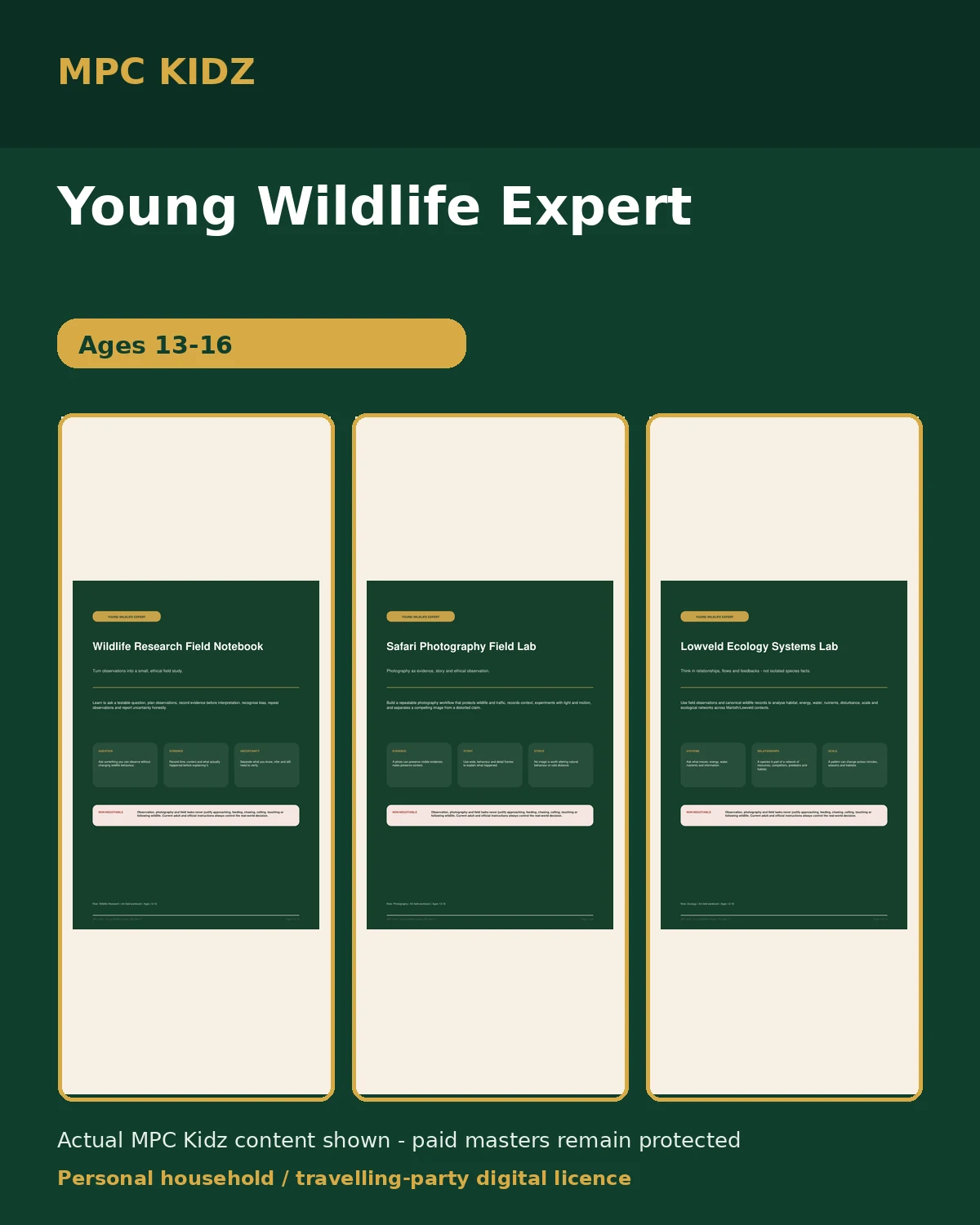
The fixed library contains Wildlife Research Field Notebook, Safari Photography Field Lab, Lowveld Ecology Systems Lab, Track & Sign Evidence Lab, Conservation Decisions Casebook, Southern Kruger Challenge Lab, Species Identification & Verification Lab and Advanced Route Reasoning Lab. Each module has a distinct analytical role rather than duplicating the younger packs.
03Research remains ethical and non-invasive
Field research in MPC Kidz means recording what can be safely observed, comparing evidence and recognising uncertainty. It does not mean handling animals, collecting sensitive location data, following dangerous wildlife or publishing real-time wildlife positions. Photography uses distance and patience.
04Route and systems thinking should support better decisions
Advanced route reasoning can explore constraints, time margins and trade-offs, but it remains educational. It is not a live navigation engine and cannot override current closures, gate times, road conditions or official instructions. Ecology and conservation modules similarly encourage reasoned discussion rather than presenting a child’s worksheet as professional environmental advice.