01Older children can explain why, not only what
At ages 9–12, activities can move beyond spotting a zebra or matching a card. Bush Detective asks the learner to compare clues, consider alternatives and explain why an identification or conservation decision makes sense. This is where incomplete evidence becomes part of the learning rather than something to hide.
02The 11 Bush Detective activities
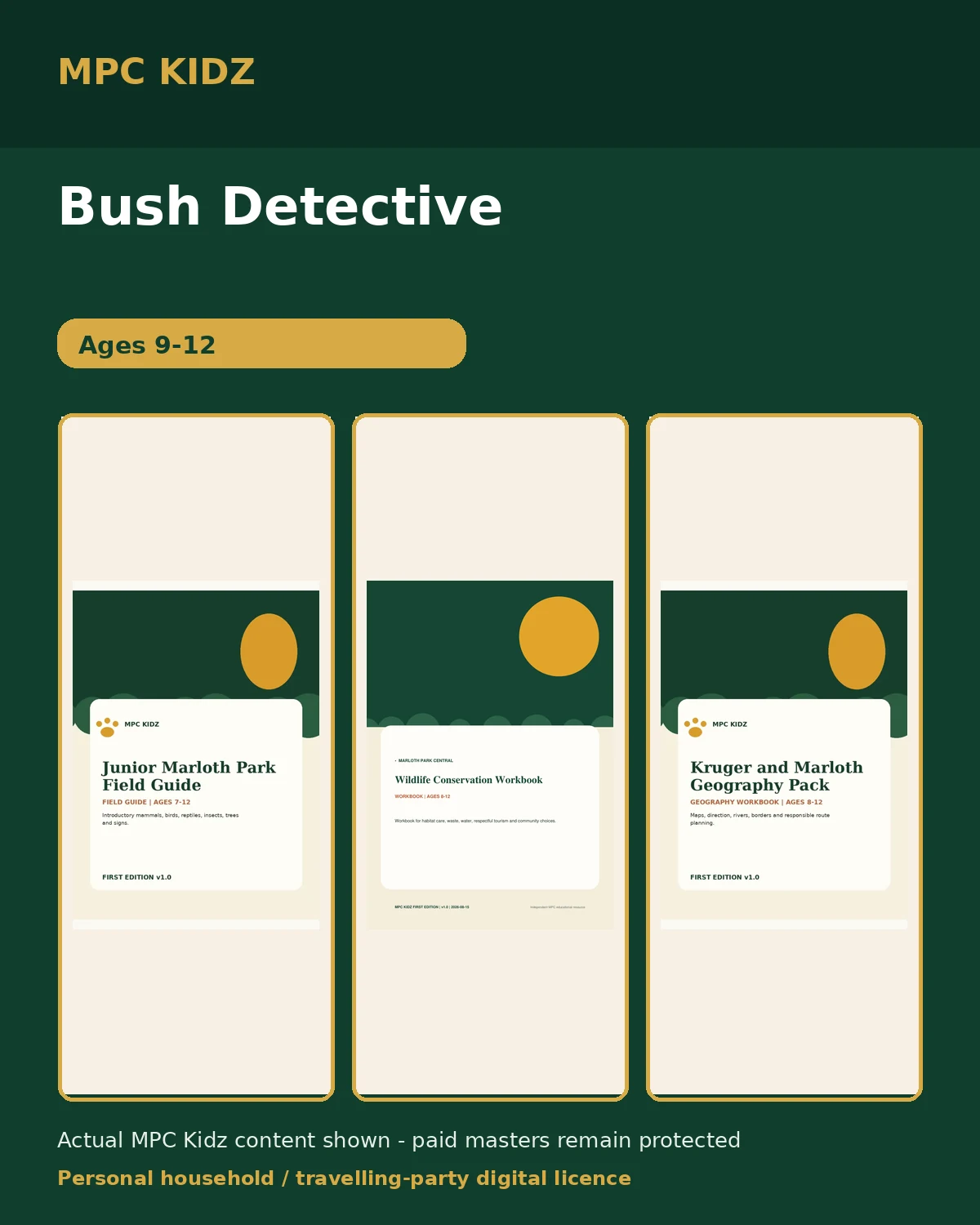
This pack contains Junior Marloth Park Field Guide, Animal Tracks Detective Kit, Who Left This Behind? Activity Pack, Junior Tree Identification Pack, Marloth Park Junior Ranger Course, Wildlife Conservation Workbook, Food Chain and Ecosystem Kit, Predator or Prey Card Game, African Wildlife Sudoku, Junior Photographer Challenge Book and Kruger and Marloth Geography Pack.
03Photography and geography remain safety-bound
Photography challenges use patience and zoom rather than closing distance. Geography work develops reasoning about place and route factors but is not navigation-grade mapping. Current road conditions, official closures, gate information and adult driver decisions always override stored educational material.
04This age band can own more of the reflection
A child can keep a field note, review a photo for identifying features, compare a track diagram or explain a food-chain relationship after the outing. Adults still control access, purchases and safety, but the learner can take more responsibility for organising evidence and acknowledging uncertainty.