The useful answer first
What you need to know
Wildlife in Marloth Park must be treated as wild even when it appears relaxed near homes. Keep a respectful distance, never corner or touch an animal, secure all food and refuse, never feed primates, supervise children closely, use a torch around the property after dark and follow current local rules, host instructions and emergency guidance.
Distance, food control and calm decisions prevent most problems
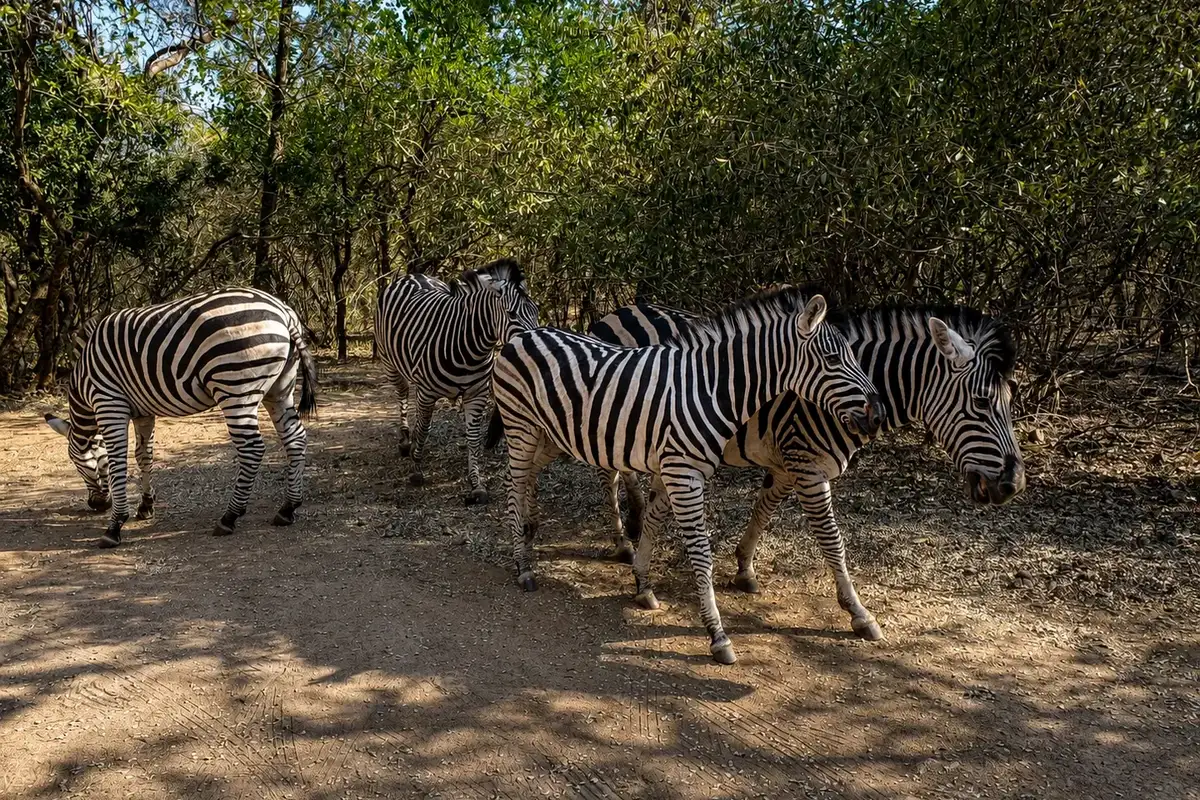
Marloth Park's appeal comes from proximity. Zebra may cross the driveway, kudu can stand beyond a low wall and giraffe may feed beside a road. That closeness can create a false impression of domestication. The animals are not pets and do not owe visitors tolerance.
Good wildlife safety is not fear. It is a repeatable system: give space, leave an escape route, control food, keep children close and stop the encounter before the animal has to make the decision for you.
- Safest default
- Stay still or increase distance
- Highest preventable risk
- Human food, open refuse and deliberate feeding
- Child rule
- An adult remains close enough to intervene immediately
- Night rule
- Observe from a secure property area and follow current local restrictions
Know the ordinary neighbours before worrying about rare ones
| Animal | What visitors may notice | Better response |
|---|---|---|
| Zebra | Groups on roads or near homes | Slow down, do not walk into the group and leave the road open |
| Giraffe | Feeding above shrubs or crossing roads | Give wide space and watch for a second animal |
| Kudu | Quiet movement near vegetation and homes | Avoid sudden approach; horns and escape reactions require room |
| Warthog | Feeding low to the ground or moving quickly | Do not stand between adults and young or block a retreat |
| Bushbuck | Secretive movement close to cover | Observe quietly and do not follow into vegetation |
| Vervet monkey | Roofs, trees and food surveillance | Close food access and never feed |
| Baboon | Confident group movement and active search for food | Secure people and food; contact local help if it enters |
| Ostrich | Large bird moving through open areas | Keep distance; kicks can be powerful |
Larger predators and hyena may occasionally move through or near the wider area. Do not search for them on foot, follow vehicles toward rumours or publish a live location that attracts traffic. Current official and local instructions take priority over social-media excitement.
Read the animal's need for space before it escalates
There is no universal safe distance expressed in metres. Species, age, young animals, food, barriers and the animal's behaviour all matter. Use the response of the animal as evidence: if it stops feeding, fixes attention on you, changes direction, raises its head repeatedly or cannot see a clear route away, increase distance.
- Never position yourself between an animal and cover, water, young or its group.
- Do not surround an animal with several people or vehicles.
- Keep doorways and paths clear so people can retreat without running.
- Use zoom rather than physical approach.
- Lower voices and avoid sudden movement.
- Stop the encounter when the animal becomes alert to you.
Secure food as though a clever animal is watching—because it may be
Primates learn patterns quickly. An open window, unattended fruit bowl, outside bin or guest who feeds once can teach an animal to return. The resulting conflict is carried by the property, neighbours and wildlife long after the visitor leaves.
- Keep doors and windows closed or properly screened when food is visible.
- Do not leave fruit, bread, snacks or braai food unattended outside.
- Use secure refuse storage and remove food residue from braai areas.
- Never throw scraps into the bush.
- Do not use food to attract an animal for children or photographs.
- Never feed vervet monkeys or baboons.
If a primate enters:
- Move children and vulnerable guests away without screaming or running.
- Do not stand between the animal and its exit.
- Do not offer food, corner it or attempt physical removal.
- Close additional access points when this can be done safely.
- Call the host or current local security contact for guidance.
- Afterward, identify and remove the food or access condition that attracted it.
Children need a boundary they can understand before the animal appears
“Be careful” is not a complete rule. Give children simple instructions: stay beside an adult, never run toward or away from an animal, never hold out food, and go inside when the adult says so. Practise the instruction before the first encounter.
- Keep toddlers within arm's reach outdoors.
- Use one named adult as the active supervisor near wildlife or water.
- Do not allow children to open doors for a better view.
- Stop ball games or running when wildlife enters the area.
- Keep food out of children's hands when primates are nearby.
- Inspect pool barriers and gates at check-in.
- Use close, continuous supervision around pools; wildlife safety does not replace water safety.
A calm indoor observation can be more memorable than a close outdoor encounter. Children learn respect when adults model patience rather than excitement at any cost.
Do not turn a small-creature sighting into a handling incident
Snakes, scorpions, spiders, geckos and insects are part of the Lowveld environment. Most encounters end safely when people stop, create distance and call the right person. Attempts to identify by getting closer, catch with household tools or kill the animal create avoidable risk.
- Use closed shoes outside, especially after dark.
- Shake out shoes and clothing that have been left on the floor or outside.
- Use a torch rather than stepping into unlit areas.
- Keep bedding and luggage orderly rather than spread across the floor.
- Do not place hands into holes, wood piles or unseen spaces.
- Call a qualified snake responder through the host or security.
Night changes visibility, animal movement and the cost of a mistake
Commonly published Marloth Park visitor rules prohibit walking and cycling between 18:00 and 06:00. Confirm current rules with your host or relevant local authority and follow stricter instructions when given. Driving is not permission to rush; animals, pedestrians and road edges can be difficult to see.
- Finish supplies and orientation before dark where possible.
- Carry a torch for safe footing around the property.
- Do not use lights to chase, harass or follow wildlife.
- Keep doors secured and food packed away before sitting outside.
- Listen from a secure area rather than walking toward a sound.
- Tell another adult before moving around the property at night.
In an emergency, location comes before explanation
Save the current local security, host and emergency numbers before arrival. Know the property name, stand number, street and a shareable map pin. When calling, state the location and immediate danger first, then explain what happened.
- Move people away from continuing danger without creating a second hazard.
- Call the appropriate emergency or local response service.
- Give the exact location first.
- Follow the operator's instructions and do not improvise treatment that conflicts with them.
- Send one person to guide responders if safe.
- Keep the rest of the group calm, together and out of the response area.
MPC is an independent visitor-information platform, not an emergency authority. Live emergency operators, property hosts, local security and official authorities override stored guidance.
Check before travelling
Official and practical planning links
Gate times, fees, road conditions, supplier availability and local operating details can change. Use these links as the final check before relying on any time-sensitive detail.
Quick clarifications
Frequently asked questions
Is it safe to walk in Marloth Park?
Daytime walking still requires awareness, distance from wildlife and compliance with current local rules. Commonly published local visitor rules prohibit walking or cycling between 18:00 and 06:00. Confirm current instructions with the property host or relevant local authority.
Can visitors feed animals in Marloth Park?
MPC's safest visitor position is not to feed wildlife. Never feed primates. Feeding changes animal behaviour, concentrates animals near people and can create conflict for future guests and residents.
What should I do if a baboon enters the property?
Keep people, especially children, inside or well away; do not offer food, corner or challenge the animal; close access routes when safe; and contact the host or local security for current guidance.
What should I do if I see a snake?
Stop, move people and pets away, keep a safe visual reference without approaching, and call a qualified local snake responder through the host or security. Do not attempt to catch or kill it.